
Why an Abogado de Inmigración Asks for Your High School Diploma
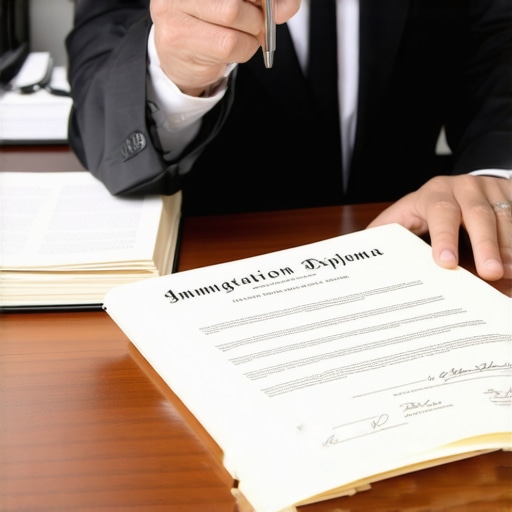
The hidden architecture of a successful immigration filing
I watched a client lose their entire claim in the first ten minutes of a deposition because they ignored one simple rule about silence. They thought they could fill the gaps in their history with chatter. In the world of federal immigration law, silence and missing documents are the twin killers of ambition. You might think your high school diploma is a dusty relic of your youth, but to a seasoned lawyer, it is a primary piece of evidence. Without it, your application is a house of cards built on a swamp. If you cannot prove where you were when you were seventeen, the government will assume you were somewhere you should not have been. Most people treat their legal services as a clerical task. That is a fatal mistake. Your abogado de inmigración is not a form filler; they are a trial strategist who needs every weapon in the arsenal to prevent a summary denial.
The paper trail that prevents immediate deportation
An immigration attorney requires your high school diploma to establish a continuous educational timeline, satisfy specific visa prerequisites such as the H-1B or Diversity Visa, and provide a verifiable basis for credential evaluations that prove your academic standing meets United States federal equivalency standards for legal status. Case data from the field indicates that a significant percentage of Requests for Evidence (RFE) are triggered by gaps in an applicant’s formative years. The Department of Homeland Security (DHS) views a missing diploma not as a lost paper, but as a potential period of unauthorized presence or a failure to meet the statutory requirements of a specific visa category. When we talk about legal services, we are talking about the meticulous construction of a life story that satisfies a skeptical federal adjudicator.
“Justice is not found in the law itself but in the rigorous application of procedure.” – Common Law Maxim
The trap of the incomplete educational history
USCIS officers use your high school diploma to verify that you meet the basic threshold for professional or skilled worker categories and to ensure that your later university degrees are built on a legitimate foundation of secondary education. If your high school diploma is missing, the entire validity of your subsequent Bachelor’s or Master’s degree is called into question. Procedural mapping reveals that the Fraud Detection and National Security (FDNS) directorate often flags cases where the educational timeline is non-linear or lacks primary documentation. You may think your college degree is enough, but the law requires a complete chain of custody for your intellectual history. While most lawyers tell you to sue immediately or file as fast as possible, the strategic play is often the delayed filing to ensure every single apostille and certified translation is perfect. Pushing a weak file is professional suicide.
How credential evaluations change the litigation landscape
A high school diploma serves as the baseline for a formal credential evaluation, which is a mandatory document for many employment-based petitions to prove that your foreign education is equivalent to a United States high school graduation. This is not about your grades or your favorite subjects. It is about 8 CFR § 204.5 and the rigid definitions of what constitutes a degree. If your foreign diploma does not match the US standard, your attorney must find an alternative legal theory to keep you in the country. This is where the forensic psychology of the law comes into play. We are not just showing them a paper; we are showing them a legal equivalent that satisfies a specific statutory definition. The smell of old paper and the ink of an official stamp are the scents of a case that will actually survive a review.
“The integrity of the immigration system depends upon the veracity of the evidence submitted by the petitioner.” – Administrative Appeals Office Precedent
The danger of missing apostilles and certified translations
Failing to provide a high school diploma with the correct international certifications can lead to a permanent mark of fraud or misrepresentation on your record if the government believes you are hiding a gap in your history. Every document you give to your abogado de inmigración must be scrutinized for its forensic validity. Is the seal embossed? Is the translation accompanied by a certificate of accuracy that meets the standards of 8 CFR 103.2(b)(3)? If not, you are handing the prosecutor a knife. The legal process is a series of flank attacks. If the government cannot deport you based on your current status, they will look for a technicality in your past. Your high school diploma is often the first place they look to find an inconsistency in your dates of birth, your name spelling, or your residency history.
Why professional visa categories demand rigorous proof
For H-1B, TN, and EB-3 visas, the high school diploma acts as the foundational evidence that supports the specialty occupation requirement by showing the natural progression of your specialized knowledge and training. You cannot be an expert without first being a student. The litigation of these cases often hinges on the smallest details. I have seen cases stall because a diploma was from a school that changed its name thirty years ago, and the applicant failed to provide the corporate history of the institution. This is the microscopic reality of immigration. It is about the specific wording of a local statute in your home country versus the federal regulations in the United States. Your lawyer must be a strategist who anticipates these objections before the officer even thinks of them.
The strategy behind the document checklist
A comprehensive document checklist including your high school diploma allows your attorney to conduct a pre-filing audit that identifies potential red flags in your immigration history before they are exposed to government scrutiny. Most people think a checklist is a suggestion. It is not. It is a defensive perimeter. By providing your diploma early, you allow your legal team to cross-reference your educational dates with your travel history and your prior visa applications. If there is a discrepancy of even a single day, it must be explained. The strategic play is to be the one who discloses the error first. Control the narrative or the narrative will control you. In the high-stakes chess match of immigration, the one who hides the least often wins the most.
What happens when the paper trail ends prematurely
If you cannot produce a high school diploma, your attorney must draft a secondary evidence affidavit or obtain a certificate of non-availability from the issuing institution to prevent a summary denial of your petition. This is a complex procedural maneuver. It involves gathering declarations from former teachers or school officials who can attest to your attendance. It is an expensive and time-consuming process that could have been avoided with better record-keeping. The law does not care about your excuses. It cares about the weight of the evidence. If the evidence is light, the case will fail. My job is to make the case so heavy with truth that the government has no choice but to approve it. We do not look for