
Why Your Abogado de Inmigración Needs Your Original Marriage Certificate
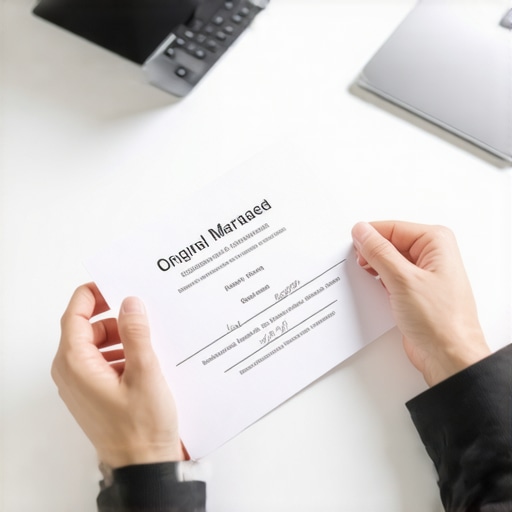
The air in a legal office usually smells of stale coffee and printer toner. It is the scent of a machine that grinds human lives into paper. I have spent twenty-five years watching people walk into my office with a folder full of dreams and a stack of blurry photocopies. They think the story is enough. They think their love is enough. It is not. In the world of high-stakes litigation and federal immigration proceedings, only the original document carries the weight of truth. If you show up to a filing without the actual, embossed, physical marriage certificate, you are not just being careless. You are handing the government a reason to delete your file.
The shadow of the secondary evidence rule
An Abogado de Inmigración requires the Original Marriage Certificate to satisfy the Best Evidence Rule within Immigration Law. This legal standard mandates that a party must provide the Original Document to prove its content unless it is unavailable. Failing this creates a rebuttable presumption of fraud or document manipulation during the Adjustment of Status process. I recently watched a client lose their entire claim because they ignored one simple rule about the physical integrity of their evidence. We were sitting in a sterile room in lower Manhattan. The officer looked at a photocopy of a certificate from 2012. The ink was faded. The edges were clipped. Because the client could not produce the original with the raised seal, the officer flagged the case for a secondary fraud investigation. That single oversight turned a six-month process into a three-year nightmare. The system does not care about your intentions. It cares about the tactile reality of the paper in the officer’s hand. If the paper does not feel right, the case is wrong.
Why photocopies invite fraud investigations
USCIS officers and Department of Homeland Security agents are trained to identify Digital Manipulation and Document Fraud through the analysis of Security Features on original records. A photocopy hides the Watermarks, Intaglio Printing, and Embossed Seals that prove a document is a Valid Legal Record issued by a government authority. When you provide a copy, you are essentially asking the government to trust your scanner. They don’t. They assume every copy is a potential forgery until the original proves otherwise. The legal reality is that a photocopy is a shadow. You cannot cross-examine a shadow. You cannot verify the depth of a stamp on a flat piece of thermal paper. This is why the attorney is so aggressive about the original. We are not being difficult. We are preventing a fraud referral that could end in a permanent bar from the United States. Every grain of toner on a copy is a place where a lie could hide. The original is naked. It shows its age, its origin, and its truth. If there is a smudge on the signature, we need to see if it happened in 1995 or 2024.
“Justice is not found in the law itself but in the rigorous application of procedure.” – Common Law Maxim
The microscopic anatomy of a civil document
Every Marriage Certificate issued by a Civil Registrar contains Micro-printing and Latent Images that are invisible to the naked eye but clear under Forensic Examination. An Immigration Attorney inspects these features to ensure the Petitioner meets the Burden of Proof for a Bona Fide Marriage. These microscopic details are lost in digital translation. Consider the weight of the paper. Standard government-issued security paper has a specific GSM (grams per square meter) count. It has a specific texture. When an officer holds the original, they are conducting a tactile audit. They are feeling for the indentation of the typewriter or the specific drag of the fountain pen used by the clerk. A photocopy is smooth and soulless. It provides no sensory data. In a courtroom, sensory data is the difference between an exhibit being admitted or being tossed into the trash. We look at the chemical composition of the ink. We look at the way the paper has yellowed. These are the markers of authenticity that a Xerox machine cannot replicate. If you want the government to believe your marriage is real, you must provide a document that is physically real.
How USCIS officers detect digital manipulation
Adjudicating Officers utilize Ultraviolet Light and Magnification Tools to verify the Authenticity of Government Documents during a Green Card Interview. If a document is a Photocopy, these tools are useless, forcing the officer to issue a Request for Evidence (RFE) which delays the Immigrant Visa. This is the death of a case by a thousand cuts. Every RFE is a new window for the government to find a discrepancy. I have seen cases where the officer doubted the font used on a copy. They claimed the “7” looked like it had been altered from a “1”. In the original, you could see the continuous stroke of the pen. In the copy, it looked like a suspicious pixel. This is the tactical reality of the grind. You are not just proving you are married. You are proving that you didn’t hire a graphic designer to fabricate a life. The officer’s job is to find a reason to say no. Don’t give them a reason that fits on a scanner bed. The original certificate is your shield. It is the only thing that stands between you and a bored government employee with a denial stamp.
The evidentiary burden of the Petitioner
The Legal Burden in any Immigration Proceeding remains entirely on the Applicant to prove Eligibility through Competent Evidence. According to 8 CFR 103.2, while Secondary Evidence may be submitted, it is only acceptable if the Original Document is demonstrably Unavailable through a Certificate of Non-Availability. This is not a suggestion. It is a command. If you have the original and you simply don’t want to mail it or bring it, you are failing your legal burden. The law does not reward convenience. It rewards compliance. I have had clients tell me they are afraid to lose the original in the mail. My response is always the same. What is worse? Losing a piece of paper or losing your right to live in this country? We use secure couriers for a reason. We use vaulted storage for a reason. The original is the currency of the court. You cannot buy a verdict with counterfeit bills, and you cannot buy a visa with a PDF. We must be prepared to present the artifact itself, not a picture of the artifact.
“The burden of proof in an immigration proceeding never shifts from the petitioner to the government.” – Matter of Brantigan, 11 I&N Dec. 493 (BIA 1966)
Tactical advantages of the original file
Maintaining a Complete Original File allows an Immigration Lawyer to perform a Document Audit before the Government ever sees the Evidence. This proactive Litigation Strategy identifies Inconsistencies in Dates, Names, or Jurisdictional Authority that could lead to a Notice of Intent to Deny (NOID). I look for the small things. Does the seal of the court match the year of the signature? Is the registrar’s name spelled correctly? Sometimes, the original reveals a mistake made by the government clerk years ago. If we find that on a photocopy, it looks like fraud. If we find it on the original, it is clearly a clerical error. That distinction saves lives. We need to see the back of the paper. Often, there are stamps on the reverse side that the client didn’t think to scan. Those stamps might prove the document was recorded in the national registry, which is a foundational requirement for certain jurisdictions. The original tells the whole story, front and back, margin to margin. A copy is a censored version of the truth.
Risks of the Request for Evidence loop
A Request for Evidence regarding Identity Documents or Civil Records triggers a Mandatory Tolling of the Processing Timeline. This Administrative Delay can last for months, during which the Work Authorization or Travel Permit might expire, leaving the Beneficiary in a state of Legal Limbo. This is the trap. You think you’re saving time by sending a copy now and finding the original later. You aren’t. You are pausing the clock. In this office, we do not pause the clock. We move with the aggression of a trial team. We want the officer to have everything they need to approve the case on the first pass. If they have to pick up a pen to write a letter asking for the original, you have already lost the momentum. The officer’s mood shifts from “approval” to “inquiry.” Once you are under inquiry, every other part of your life is fair game. They will look closer at your taxes. They will look closer at your joint bank accounts. All because you didn’t want to find the original marriage certificate. It is a cascading failure of strategy. It is an amateur move in a professional arena. We don’t play that way. We bring the original, we win the point, and we move to the next phase of the battle.