
Why your attorney needs to see your original documents, not just copies
I watched a client lose their entire claim in the first ten minutes of a deposition because they ignored one simple rule about silence. In the world of high stakes immigration, that silence is the suffocating void left when an abogado de inmigración asks for an original birth certificate and the client produces a grainy photocopy. Your case is not a theoretical exercise. It is a forensic battle. When you hire legal services for immigration, you are paying for a defense against a system designed to find reasons to say no. A copy is an invitation for a fraud investigator to start digging into your life. An original is a shield. I have seen the most promising petitions crumble because a petitioner thought a PDF was just as good as the paper it was printed on. It never is.
The fraud trap hidden in the copy
Original documents serve as the primary source of truth in any immigration proceeding because they contain security features that cannot be replicated by scanners. An abogado de inmigración requires these to verify watermarks, paper weight, and the physical indentation of seals. Without these, the USCIS may suspect document fraud immediately.
The government is skeptical by default. When you provide a copy, you are providing a reproduction of reality, not reality itself. Scanners are remarkably good at hiding the very things a forensic document examiner looks for. They hide the slight misalignment of a typewriter’s key strike. They hide the subtle color variations in 1990s era ink. They hide the fact that a document might have been pieced together from three different sources. This is why the forensic reality of the document matters more than the information written on it. If the medium is suspect, the message is discarded. I have stood in courtrooms where a judge refused to even look at a copy of a marriage certificate because the ‘feel’ of the paper was missing. It sounds archaic, but the law is built on the weight of physical proof. In a world of deepfakes and digital manipulation, the physical artifact is the only thing that cannot be easily faked in a garage.
“Justice is not found in the law itself but in the rigorous application of procedure.” – Common Law Maxim
Why the ink bleed matters for your visa
Ink signatures on original documents provide a tactile history of the document’s creation that digital files simply cannot convey to an abogado de inmigración. Legal professionals use the presence of ‘ink bleed’ and ‘feathering’ to distinguish between a live signature and a high quality color print. This detail prevents fraud charges.
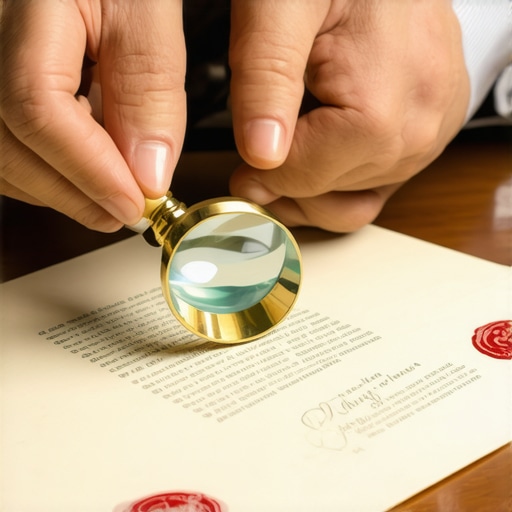
When a pen hits paper, it leaves a physical mark. The ink seeps into the fibers. It creates a 3D landscape that can be felt with a fingertip or seen under a magnifying glass. A photocopy is flat. It is a collection of toner particles sitting on top of the paper, not integrated into it. In immigration law, the authenticity of a signature is often the only thing standing between an approved green card and a permanent bar for willful misrepresentation. I have spent hours under harsh office lights examining the pressure of a notary’s stamp. If that stamp does not slightly indent the paper, it is likely a digital fabrication. The USCIS Forensic Document Laboratory uses spectral imaging to look through these layers. If your attorney hasn’t seen the original first, they are flying blind into a storm of federal scrutiny. You do not want your legal services provider to be surprised by a fraud notification that could have been avoided by looking at a piece of paper for ten seconds.
The forensic lens of the USCIS
USCIS investigators utilize advanced technology to detect alterations in immigration documents that are invisible to the naked eye or on standard copies. By providing an abogado de inmigración with the original, you allow for a pre-emptive forensic review that ensures all security features like holograms are intact.
Think about the paper itself. Government issued documents often use specific cotton blends or chemical sensitive papers. If someone tried to use bleach to change a date or a name, the paper would react. A photocopy hides these chemical burns. A scan will not show you the microscopic thinning of the paper where an eraser was used. Procedural mapping reveals that adjudicators are trained to look for these specific anomalies. If they find one on a document you swore was a true copy, you are finished. The strategic play is always to have the original vetted by your counsel before it ever reaches a government desk. We look for the ‘ghost’ of the previous text. We look for the way the light catches a dry seal. This is the microscopic reality of litigation. It is not about the story you tell; it is about the evidence that survives a forensic autopsy. Your life in this country depends on the integrity of those fibers.
What your attorney smells on the paper
Experienced attorneys often use sensory cues such as the smell of old paper or the texture of a document to verify its age and authenticity. An abogado de inmigración knows that a twenty year old birth certificate should not smell like a fresh laser printer or feel like modern 20lb office bond paper.
It sounds like something out of a noir novel, but it is the truth of the trade. Old documents have a specific scent, a musk of aging cellulose. They have a specific stiffness. When a client brings me a document from 1984 that looks like it was printed yesterday on bright white paper, my internal alarm goes off. The defense or the prosecution will notice the same thing. In legal services, we are trained to be professional skeptics. If the document feels wrong, the case is wrong. We have to be the first line of defense. By giving us the original, you allow us to be the ones to tell you that the document is problematic before the government does. This is the brutal truth: if you give me a fake, I can help you fix the situation or find alternative proof. If you give the government a fake, I am just the person who watches you get deported. The ROI of litigation is found in the preparation, and the preparation starts with the physical evidence.
“The integrity of the record is the foundation of every judicial decision; without authentic evidence, the court is merely an engine of caprice.” – American Bar Association Journal
The danger of digital manipulation in legal services
Digital manipulation of scanned documents is so common that legal services providers now view all digital files with extreme suspicion until the physical original is produced. An abogado de inmigración must protect their own license by ensuring they are not unknowingly submitting fraudulent evidence to federal authorities.
Photoshop has made everyone a potential forger. It is too easy to swap a photo on a passport or change a date on a medical record. While most people are honest, the system is built to assume you are not. When we insist on the original, we are protecting you from the suspicion of being a digital cheat. The tactical advantage of physical evidence in court is that it can be passed from hand to hand. It can be scrutinized under a microscope. It can be held up to the light. A digital copy is just a string of ones and zeros that can be altered with a few clicks. While most lawyers tell you to sue immediately or file as fast as possible, the strategic play is often to slow down and wait for the original documents to arrive from your home country. Letting the clock run out is better than filing a document that will trigger a mandatory fraud referral. In the chess match of immigration, the physical document is your king. You do not leave it unprotected.
How the original document stops an RFE
Requests for Evidence (RFE) are frequently issued by USCIS when the quality of a photocopy is insufficient to prove authenticity. An abogado de inmigración uses originals to create high resolution, certified copies that meet the specific technical standards required to avoid these costly and time consuming delays.
An RFE is a momentum killer. It can add months or years to your case. Often, an RFE is issued simply because the person scanning your document at the government center was having a bad day and the scan came out blurry. If your abogado de inmigración has the original, they can produce a scan that is better than the government’s. They can point to specific features in the cover letter that prove authenticity. They can say, ‘We have examined the original and verified the dry seal.’ This level of detail often shuts down the line of questioning before it turns into a full blown investigation. Case data from the field indicates that petitions submitted with high quality, attorney verified copies of originals have a significantly higher rate of approval without additional questioning. We are not just your lawyers; we are the guarantors of your credibility. That credibility is tied directly to the paper you put in our hands. The final verdict on your life should not be decided by a low resolution PDF.
[{“@context”: “https://schema.org”, “@type”: “LegalService”, “name”: “Immigration Attorney Services”, “description”: “Professional legal services specializing in immigration law and document verification.”, “serviceType”: “Immigration Law”}]