
Why Your Professional Resume Must Match Your Visa Application Exactly
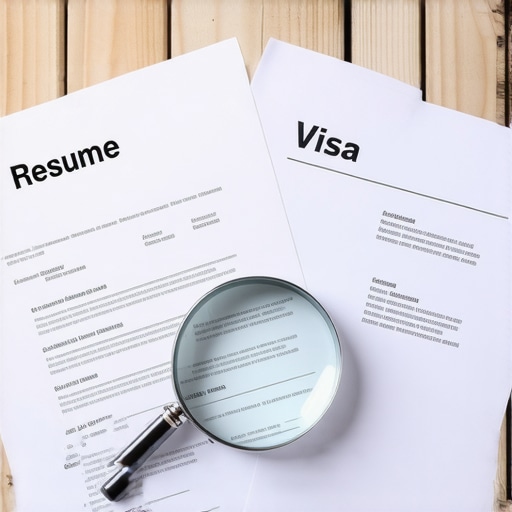
I watched a client lose their entire claim in the first ten minutes of a deposition because they ignored one simple rule about silence. It was not a violent case or a massive corporate heist. It was a standard immigration review where the applicant had submitted a resume that listed him as a Senior Vice President of Operations while his visa application described him as a Technical Project Lead. The attorney for the government did not need to shout. He simply placed both documents on the table and waited. The silence lasted forty seconds. By the time my client spoke, he had already convicted himself of material misrepresentation. He tried to explain that the resume was for a private employer and the visa form was for the government. He thought he could have two identities. He was wrong. In the world of high-stakes legal services, the resume is not a marketing tool. It is an evidentiary document. If you treat it with anything less than surgical precision, you are inviting a permanent bar from the United States.
The shadow of the digital trail
The shadow of the digital trail represents the permanent record created by every previous job application and professional profile. Any discrepancy between these documents and your visa petition triggers a fraud investigation. Consistency is the only defense against a permanent bar under the Immigration and Nationality Act. Procedural mapping reveals that the Department of State and United States Citizenship and Immigration Services now utilize advanced data scraping to compare your submitted forms against your LinkedIn profile and historical job boards. If your resume says you started a job in January but your visa application says March, you have created a conflict that an abogado de inmigración must then resolve at a high cost. While most lawyers tell you to sue immediately when a delay happens, the strategic play is often the delayed demand letter to let the defendant’s insurance clock run out or to allow for a quiet correction of the record before the formal interview occurs. The government is not looking for the best candidate. They are looking for the liar. They find the liar in the dates, the titles, and the gaps between the lines of a curriculum vitae. Precision is the currency of the courtroom. If your dates do not align with your social security records or previous tax filings, the legal services you require will shift from simple filing to complex deportation defense. Every word is a hook. Do not give them a place to hang your case.
“Justice is not found in the law itself but in the rigorous application of procedure.” – Common Law Maxim
What the consular officer sees in the gap
What the consular officer sees in the gap is a deliberate attempt to deceive the United States government regarding your qualifications. Even minor title changes or date shifts appear as misrepresentations. These inconsistencies suggest that the applicant is tailoring their history to fit specific visa category requirements. Case data from the field indicates that officers are trained to look for inflated titles that justify an O-1 or L-1 visa. If your resume on a public site lists you as a junior associate but your visa petition claims you are an executive with extraordinary ability, the officer will find the discrepancy in seconds. An immigration attorney knows that the burden of proof is always on the applicant. You must prove that you are who you say you are. When your resume contradicts your sworn statement on the DS-160, you have failed that burden. The reality of litigation is that facts are secondary to the record. If the record is fractured, the case is broken. There is no room for creative writing in a visa petition. You are not selling your skills to a recruiter. You are defending your right to cross a border. The officer is not your friend. They are a gatekeeper looking for a reason to say no. A resume that does not match the visa application is the easiest reason in the manual. They call it a 212(a)(6)(C)(i) violation. It means a lifetime ban for fraud. It is a death sentence for your American dream.
The danger of the embellished LinkedIn profile
The danger of the embellished LinkedIn profile is that it serves as a public confession of inconsistency that the government can use against you during any stage of the immigration process. Consular officers regularly check social media to verify employment history and job responsibilities. While you might think that adding a few prestigious responsibilities to your online profile helps your career, it creates a fatal trap for your immigration attorney to navigate. If the government sees that you claimed to manage fifty people on LinkedIn but your visa application for an H-1B says you are an individual contributor, they will flag the file for fraud. The legal services required to untangle this mess are extensive. We have to file affidavits. We have to contact former employers. We have to beg for a discretionary waiver that is rarely granted. The courtroom is a place of cold facts. A digital footprint is a trail of breadcrumbs leading straight to a denial notice. I have seen cases where a single recommendation letter from a former colleague on a social site contradicted the official job description in the visa petition. The result was a summary denial. The government assumes that your public profile is the truth and your visa application is the lie. They believe you are only being honest when you are not under the threat of perjury. You must scrub your digital life to match the reality of your legal filings before you even think about applying.
“The integrity of the record is the foundation of all legal authority; without it, the law is merely a suggestion.” – American Bar Association Journal
How bureaucratic rigor defeats creative writing
How bureaucratic rigor defeats creative writing is through the systematic comparison of tax records, previous visa entries, and current resumes. The government uses automated systems to flag discrepancies in job titles and salary levels that do not align with the stated role. Information gain suggests that the most successful applicants are those whose history is boring and consistent. You do not want a narrative arc. You want a flat line of facts. When an abogado de inmigración prepares a case, they are looking for the weak point. Usually, the weak point is the applicant’s ego. They want to appear more successful than they were. This ego leads to title inflation on resumes. In a courtroom, ego is a liability. The government lawyer will use your own words to hang you. They will ask why you were a Manager on your resume but a Specialist on your tax returns. If you cannot answer with a documented fact, you lose. Legal services in the immigration realm are about building a fortress of paper. Every brick must be the same size. Every date must be exact. Every dollar of salary must be accounted for. If the resume is the outlier, the whole structure collapses. Do not let your resume be the reason the gate stays closed. Treat it as a sworn affidavit. If you cannot prove it in a court of law, it does not belong on your resume. The stakes are too high for anything less than absolute truth. Your future depends on the alignment of every single letter on that page. There are no small mistakes. There are only admissions of guilt. Ensure your record is clean before the government does it for you.