
Why Your Social Media Activity Could Flag Your Visa Application
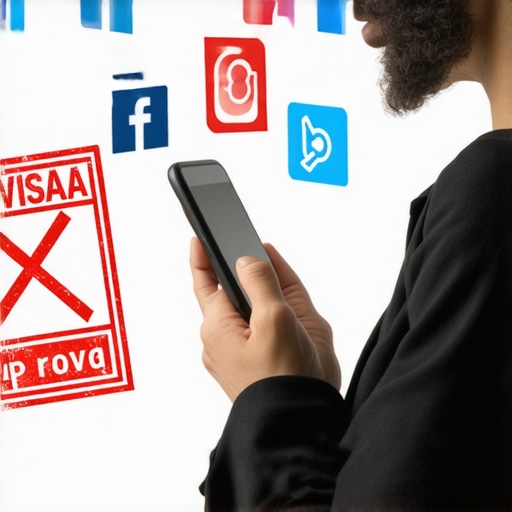
Why your social media activity triggers a visa denial
Sit down and listen. Your visa application is not a friendly request; it is a legal proceeding where the government is looking for any reason to say no. I have seen countless applicants walk into an embassy with a perfect file and leave with a permanent bar because of a single post from 2018. They think they are being clever. They think their privacy settings are a shield. They are wrong. As an experienced immigration attorney, I see the wreckage of these cases every week. The Department of State does not care about your intentions; they care about the data. If your digital footprint contradicts your petition, you are done. There is no appeal for a consular officer’s bad mood or their interpretation of a meme you shared five years ago.
I watched a client lose their entire claim in the first ten minutes of an interview because they ignored one simple rule about silence. This individual had applied for an O-1 visa, claiming extraordinary ability as a consultant. However, their Instagram was a graveyard of contradictions. They had posted photos of themselves working for a competitor three months prior while on a B-1/B-2 tourist visa. The consular officer didn’t even ask about the credentials. They simply turned the monitor around and asked, “Is this you working without authorization?” The silence that followed was the sound of a decade of planning evaporating. This is the reality of modern legal services in the immigration space. If you are not scrubbing your presence with the same rigor a prosecutor uses to build a racketeering case, you are gambling with your future.
The digital trail that destroys your credibility
Your social media activity serves as a primary evidentiary basis for assessing your credibility during the visa adjudication process. Consular officers utilize your handles provided on the DS-160 to cross-reference your stated employment, marital status, and travel intentions against your public and semi-private digital history to identify material misrepresentations. Case data from the field indicates that discrepancies between a LinkedIn profile and a CV are the most frequent triggers for administrative processing. If your resume says you are a Senior Manager but your LinkedIn shows you are currently looking for entry-level work, the officer sees a fraudster. They do not see an outdated profile. They see a lie. This is where the expertise of an abogado de inmigración becomes indispensable. We do not just fill out forms; we perform forensic audits of your life before the government does.
Procedural mapping reveals that the Department of State’s High-Tech Tactical Mapping systems are increasingly automated. They are not just looking for keywords like “protest” or “jihad.” They are looking for patterns of behavior. If you claim you are visiting the United States for a two-week vacation but your Facebook groups show you are actively looking for apartments in Queens, you have demonstrated immigrant intent. Under Section 214(b) of the Immigration and Nationality Act, the burden of proof is on you to prove you will leave. Your own digital breadcrumbs are providing the evidence to sustain a denial. While most lawyers tell you to sue immediately, the strategic play is often the delayed demand letter to let the defendant’s insurance clock run out or, in this case, a strategic withdrawal before a formal finding of fraud is entered into the system.
Consular officers as forensic social media auditors
Officers at the Department of State are trained to act as forensic auditors of your social media presence to verify the bona fides of your application. They examine timestamps, geotags, and peer interactions to ensure that the narrative provided in your visa petition aligns with your lived digital reality. Any deviation is treated as a potential ground for inadmissibility under Section 212(a)(6)(C)(i). It is a cold, clinical process. They are not your friends. They are gatekeepers looking for a reason to close the door. When you seek immigration assistance, you need someone who understands the backend of these investigations. The officer has access to tools that can scrape data even if you think it was deleted. The internet is forever, and in the world of legal services, forever is a very long time for a mistake to haunt you.
“Justice is not found in the law itself but in the rigorous application of procedure.” – Common Law Maxim
The nuance of a deposition objection is mirrored in the silence required during a visa interview. You do not volunteer information. You do not explain. You answer the question asked. However, if your social media has already spoken for you, your silence is irrelevant. I have seen cases where a simple “check-in” at a wedding in a country the applicant claimed they had never visited triggered a permanent ban for prior visa fraud. The officer did not have to prove the applicant was there; the applicant had already proved it for them. The level of detail in these investigations is microscopic. They are looking at the background of your photos, the people you are tagged with, and even the language you use in your captions.
The trap of the hidden status update
Hidden status updates and private group participations are no longer shielded from government scrutiny due to advanced data-sharing agreements and domestic surveillance authorities. Consular officials often leverage information obtained through third-party data aggregators that have already harvested your private interactions before you even submitted your visa application form. This means that a “private” post is an illusion. If the government wants to see it, they will. This is why immigration attorney professionals warn against any digital activity that could be misinterpreted. It is not about the truth; it is about the perception of the truth created by a string of data points. If those points don’t connect in a straight line, your visa is denied.
The procedural reality is that once a denial is issued based on social media evidence, it is nearly impossible to overturn. There is no formal discovery process in consular processing. You do not get to see the evidence they have against you. You only get the result. This is why the pre-filing phase is the only time you have any leverage. An abogado de inmigración will tell you to treat your social media like a crime scene. Do not touch anything, do not move anything, and certainly do not try to hide anything after the investigation has begun. Deleting accounts right before an interview is a massive red flag that suggests you have something to hide, often leading to more intense scrutiny or a summary denial based on a lack of transparency.
Permanent records in temporary visa petitions
Every piece of data shared on social media becomes part of a permanent record that follows you through every subsequent visa application and petition for residency. The Department of Homeland Security maintains an Electronic System for Travel Authorization and other databases that archive your digital footprint for decades to ensure long-term consistency. This means a joke you made in college could resurface when you are applying for a green card twenty years later. The law is patient. The law has a long memory. When you are looking for legal services, you need a strategist who looks at the twenty-year horizon, not just the next six months. A temporary visa is just that, temporary, but a fraud finding is permanent.
“The right of a sovereign to exclude or expel aliens is a fundamental sovereign attribute.” – United States Supreme Court
Consider the logistics of a flank attack in litigation. If the government cannot find a reason to deny you on your merits, they will look for a procedural flaw. Your social media is the easiest place to find that flaw. It is the “soft underbelly” of your application. Most applicants are meticulous with their tax returns and birth certificates but reckless with their Twitter feeds. They post about their political affiliations, their grievances with the U.S. government, or their desire to work under the table. They are handing the government the sword to execute their own case. An immigration attorney must be the one to intercept that sword before it is swung.
The cost of the wrong legal advice
The financial and personal cost of receiving inadequate legal advice regarding your digital presence can result in permanent exclusion from the United States and the loss of significant filing fees. Generic consultants often overlook the tactical importance of social media audits, leading to avoidable denials that could have been mitigated with professional legal services. Many people hire “notarios” or consultants who simply fill out forms. These people are not trained in the rules of evidence. They do not understand the consequences of a material misrepresentation. They are settlement mills that disappear the moment a case gets difficult. You need a trial-ready mind to navigate the visa process today.
Statutory realities of the DS-160 require you to list every social media platform you have used in the last five years. Failing to list one is a misrepresentation. Listing one that contains incriminating evidence is a disaster. It is a Catch-22 designed to catch the unwary. The only way through is a tactical, disciplined approach to your online life. This is not about being fake; it is about being precise. It is about ensuring that the digital version of yourself is as professional and consistent as the paper version. Anything less is professional suicide. If you value your future in the United States, you will stop treating social media as a playground and start treating it as the legal evidence it has become.