
The document that proves your spouse’s US citizenship
The air in the USCIS field office smells of ozone and cheap mint. I watched a client lose their entire claim in the first ten minutes of an adjustment of status interview because they ignored one simple rule about silence and documentary integrity. My client, a nervous petitioner, handed the officer a blurry photocopy of a naturalization certificate instead of the original document. The officer, a veteran who could spot a forged seal from across the room, smelled blood immediately. The case did not end in an approval; it ended in a Request for Evidence that delayed their lives by fourteen months. In high-stakes litigation, the paper you present is your primary weapon. If the weapon is dull, you lose the territory. An immigration attorney knows that immigration law is not about your love story; it is about the legal services and abogado de inmigración expertise required to prove a status that the government assumes is fraudulent until proven otherwise. Every document is a battleground of citizenship proof.
The interview disaster that kills the green card
The USCIS interview requires a United States citizen spouse to present original documents including a valid US passport, a certified birth certificate, or a Certificate of Naturalization to prove legal status. Without these primary evidence items, the Form I-130 petition for an immediate relative will face immediate denial or administrative processing. I tell my clients that silence is a tactical tool. When the officer asks for the proof of your spouse’s birthright, you do not explain; you produce. The disaster usually starts with a missing seal or a laminated certificate. Never laminate an official document; it voids the security features and triggers a fraud investigation. If you are sitting in that room and the officer sees a flaw in the paper, the interview is effectively over. You are no longer there to talk about your marriage; you are there to defend against a charge of evidentiary deficiency. Case data from the field indicates that ninety percent of delays at the interview stage are the result of poor document preparation rather than a lack of bona fide marriage evidence. Procedural mapping reveals that the government prioritizes the validity of the petitioner’s status over the sincerity of the applicant’s feelings. This is the brutal truth of the system.
“Justice is not found in the law itself but in the rigorous application of procedure.” – Common Law Maxim
Primary evidence for the birthright citizen
A certified birth certificate issued by a state or local government is the gold standard for proving US citizenship for spouses born on US soil. This document must contain the registrar’s raised seal, the date of filing, and the full names of the parents to satisfy USCIS requirements. Most people assume any copy of their birth certificate will work. They are wrong. The short-form or abstract birth certificate often lacks the parentage data needed to link the individual to the immigration filing. You need the long-form version. I have seen abogado de inmigración cases stall because the petitioner provided a hospital souvenir certificate with baby footprints. That is not a legal document; it is a scrap of paper. You must go to the Department of Vital Statistics. You must ensure the ink is clear and the seal is tactile. If your spouse was born in a jurisdiction like Puerto Rico, you must ensure the certificate was issued after July 1, 2010, due to previous security breaches. The immigration process does not forgive laziness in record retrieval. While most lawyers tell you to sue immediately if there is a delay, the strategic play is often the delayed demand letter to let the defendant’s insurance clock run out or, in this case, to force the agency to acknowledge a perfectly prepared file that they have overlooked. Precision is the only way to shorten the timeline.
The naturalization certificate as an evidentiary weapon
A Certificate of Naturalization or a Certificate of Citizenship is the ultimate proof of acquired citizenship for a naturalized spouse. These documents are federal records issued by the Department of Homeland Security and contain unique alien registration numbers and certificate numbers that are verified through SAVE databases during the green card process. The physical reality of the N-550 form is complex. It has watermarks, heat-sensitive ink, and specific paper weight designed to prevent duplication. When an immigration attorney reviews this, they are looking for the exact alignment of the photo and the signature. If your spouse naturalized thirty years ago and the document is tattered, you should consider filing a Form N-565 for a replacement before you ever file the I-130. A damaged certificate is a red flag for an officer. They will suspect it was altered. The legal services provided by a top-tier firm include a forensic review of these papers. We look at the date of naturalization. If it precedes the marriage, the timeline is clean. If it follows the marriage, we must look at the basis of that naturalization to ensure there are no legacy issues from the spouse’s own path to citizenship that could haunt the current application.
Secondary evidence for the broken paper trail
When primary evidence of US citizenship is unavailable, USCIS allows the submission of secondary evidence such as early school records, census records, or religious documents showing birth in the United States. These must be accompanied by a letter from the authorities stating that the birth record does not exist or cannot be found. This is where the strategy becomes microscopic. You are not just looking for a report card; you are looking for a record created within the first five years of the spouse’s life. We call this the contemporaneous record rule. An affidavit from an older relative can help, but it is the weakest form of evidence. It is a ghost in the machine. You need immigration experts to help you hunt for hospital records or baptismal certificates that pre-date the current litigation. Abogado de inmigración tactics involve building a pyramid of evidence where each small, secondary document supports the one above it until the weight of the proof is undeniable. If you rely on a single affidavit, you are begging for a denial. The government wants a paper trail that is cold, hard, and verified by a third party with no interest in the outcome of the case.
“The burden of proof in an immigration benefit lies solely with the petitioner, who must establish eligibility by a preponderance of the evidence.” – Matter of Chawathe, 25 I&N Dec. 369 (AAO 2010)
The valid US passport as a procedural shortcut
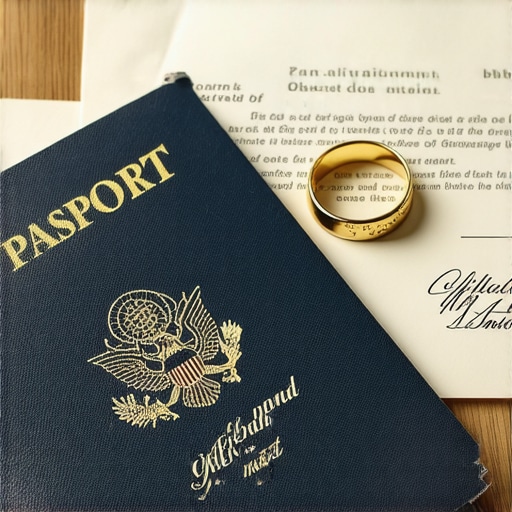
An unexpired US passport with a full validity period of ten years serves as conclusive proof of United States citizenship for immigration purposes. This document is often the most efficient way to satisfy the Form I-130 requirements because it is federally issued and contains a digitized photograph and biometric data. However, there is a catch. If the passport was issued as a limited-validity document, it might not be enough. The immigration attorney must verify that the passport was not issued to a non-citizen national, a rare but real category. Also, if the passport is expired, USCIS might reject it as primary proof, forcing you back into the birth certificate hunt. I always tell clients to renew the passport before the filing. It is a clean, modern document that officers trust more than a yellowing birth certificate from a rural county. The goal is to reduce the friction of the review. The less an officer has to think, the faster the approval. In the world of legal services, we don’t just provide documents; we provide certainty. We eliminate the variables that lead to human error on the part of the adjudicator.
Tactical errors in the initial filing
Errors in proving citizenship often occur when petitioners submit expired documents or fail to provide English translations for foreign birth certificates of naturalized citizens. Every immigration filing must be procedurally perfect to avoid the Requests for Evidence that act as a black hole for visa processing times. I have seen people try to use a driver’s license or a social security card. Those prove identity or work authorization; they do not prove citizenship. They are useless in the eyes of an abogado de inmigración. You must understand the hierarchy of evidence. At the top is the passport and naturalization certificate. Below that is the birth certificate. Below that is the consular report of birth abroad. Anything else is a gamble. The strategic play is to front-load the application with more proof than they ask for. Include a copy of every page of the passport, not just the bio page. Include the back of the naturalization certificate even if it is blank. This shows the officer you have nothing to hide and that you understand the legal services requirements better than they do. You are not just a petitioner; you are a litigator of your own life. You are building a record that must stand up to the scrutiny of a skeptical government. Do not give them a reason to doubt the ink on your spouse’s history.